The Doomsday Clock Reaches Its Most Critical Point
The Doomsday Clock moves to its most critical position and raises global alarms, marking 85 seconds to midnight this year.
Posted on 29/01/2026 at 19:45






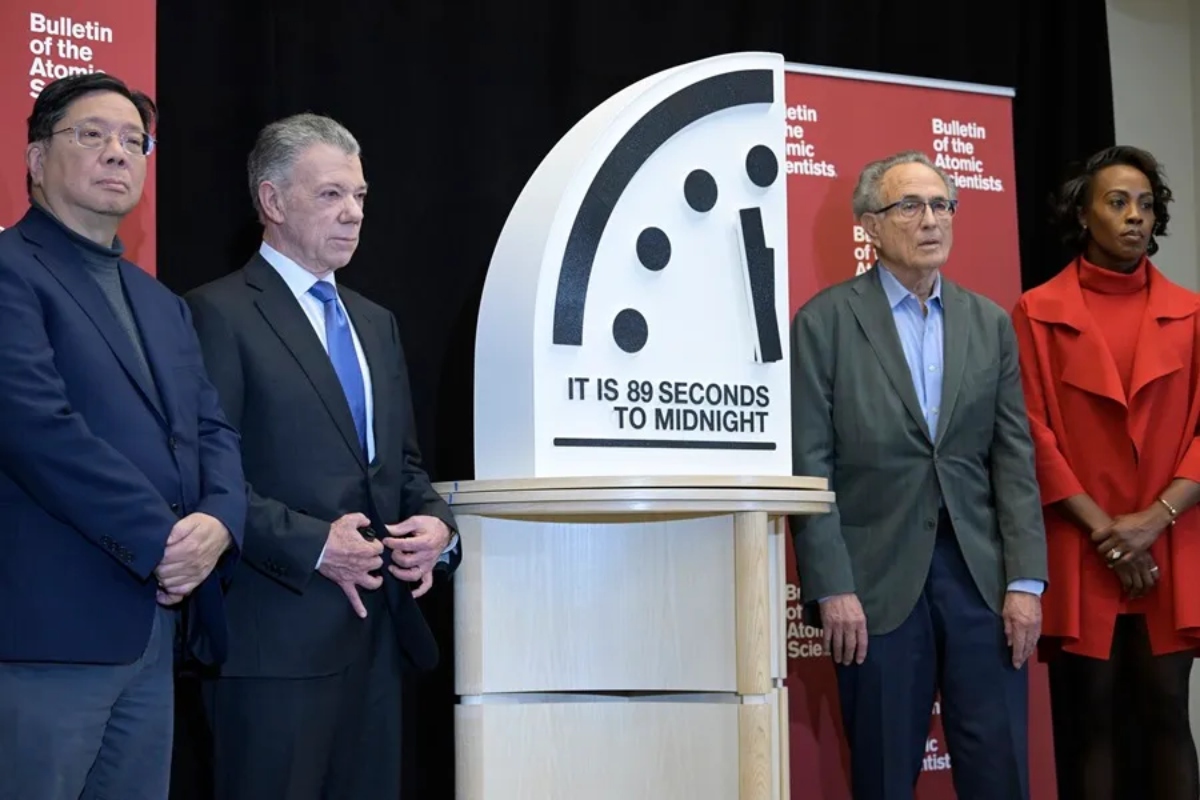
- Doomsday Clock signals maximum global risk
- Nuclear and climate threats intensify
- Scientists warn of systemic collapse
According to the EFE news agency, the so-called Doomsday Clock—a symbolic tool created by scientists to illustrate the risk of human extinction—now stands at 85 seconds to midnight.
This is the closest the clock has ever been to the end of the world in its 79-year history.
The clock is managed by the Bulletin of the Atomic Scientists’ Science and Security Board.
On Tuesday, its leaders announced that the hands moved forward by four seconds compared to last year.
In 2025, the clock stood at 89 seconds to midnight.
The update reflects, according to scientists, a worsening global scenario.
The movement of the clock is meant to warn about the growing dangers facing humanity.
Nuclear threats, climate crisis, and global tensions influence the Doomsday Clock
According to the Doomsday Clock 2026, we are 85 seconds from ‘midnight.’
The Bulletin of Atomic Scientists adjusted the Doomsday Clock today—now at 85 seconds to midnight. Nuclear risks weighed heavily… pic.twitter.com/03iJwySzvD— Clarín (@clarincom) January 27, 2026
Scientists explained that the new position responds to several accumulating factors.
Among them are the nuclear threat, climate change, and increasing aggressiveness among the world’s major powers.
They warned that nuclear arsenals continue to grow.
They also noted that nonproliferation treaties are not being renewed.
This combination raises the risk of a large-scale conflict.
You may also like: FIRED FOR USING CHATGPT! AI Costs This Soccer Coach His Job
Since 2007, the Doomsday Clock has also incorporated environmental degradation caused by global warming.
The climate crisis has become a central element in the annual global risk assessment.
Scientists emphasized that these threats do not operate in isolation.
Instead, they reinforce one another in an increasingly unstable international context.
The lack of cooperation among countries further weakens the ability to respond to these dangers.
Criticism of leadership and political decisions
Breaking news | The Doomsday Clock marks 85 seconds to midnight. Never since 1947 has the world been so close to existential collapse.
Nuclear threats, climate change, and military artificial intelligence converge at a single critical point. https://t.co/KQxI9tlAFs#ultimahora… pic.twitter.com/mLIYDIPW5q— Negocios TV (@negocios_tv) January 27, 2026
Alexandra Bell, president of the Bulletin of the Atomic Scientists, highlighted the decline of international cooperation.
Bell directly criticized decisions made by President Donald Trump’s administration.
According to her, these policies have contributed decisively to the Doomsday clock’s advance.
“Trump is actively dismantling half a century of arms control efforts,” Bell stated.
She said these actions undermine stability between the United States and Russia, the two countries with the largest nuclear arsenals.
Bell also criticized attacks on tools and technologies used to address climate change.
For her, the current scenario reflects a “blatant failure of leadership.”
She further warned of a shift toward neo-imperialism.
These dynamics, she said, increase global danger.
Democracy, journalism, and risks to humanity

The president of the Bulletin’s Science and Security Board, Daniel Holz, warned about the recent behavior of major countries.
He said they have become more “aggressive, hostile, and nationalist” over the past year.
Holz noted that history shows the consequences of a lack of accountability.
When governments stop answering to their citizens, conflict and suffering follow, he said.
This global trend, he warned, makes the world more dangerous for everyone.
During the clock’s presentation, Filipino journalist Maria Ressa also spoke.
Ressa, a Nobel Peace Prize laureate in 2021, focused on the crisis facing journalism.
She issued a call to action to reverse the global situation.
She urged technology platforms to be redesigned around human rights.
She criticized models based solely on engagement metrics.
She also called for journalism to be funded as critical infrastructure.
The Doomsday Clock—also known as the Clock of the Apocalypse—was created in 1947.
It is overseen by a group of scientists, including thirteen Nobel Prize winners.
Its purpose is to warn about the risks facing the world and to show how close humanity is to its own end.
 Related post